 Arun Kumar M
Introduction
If you’ve been following cybersecurity news lately, one thing is clear: attacks aren’t just increasing — they’re evolving.
A few years ago, most cyberattacks relied heavily on manual effort. Today? Hackers are using artificial intelligence to automate phishing emails, generate malware, and even mimic human voices. The speed at which threats are evolving is honestly overwhelming.
But here’s the interesting part.
The same technology attackers are using — AI — is also becoming our strongest defense. So the real story isn’t “AI vs humans.”
It’s AI helping humans fight hackers faster than ever before.
The Reality: Humans Alone Can’t Keep Up Anymore
Let’s be honest.
Modern organizations generate massive amounts of data every second — login attempts, file transfers, API calls, network traffic, cloud activity. A security team simply cannot manually analyze all of it.
That’s where AI steps in.
Instead of waiting for someone to notice suspicious activity, AI systems monitor patterns continuously. They don’t get tired. They don’t miss alerts because of overload. They process millions of signals in real time.
In many cases, AI can detect a breach in seconds — something that used to take days or even weeks.
How Hackers Are Using AI (And Why That’s Scary)
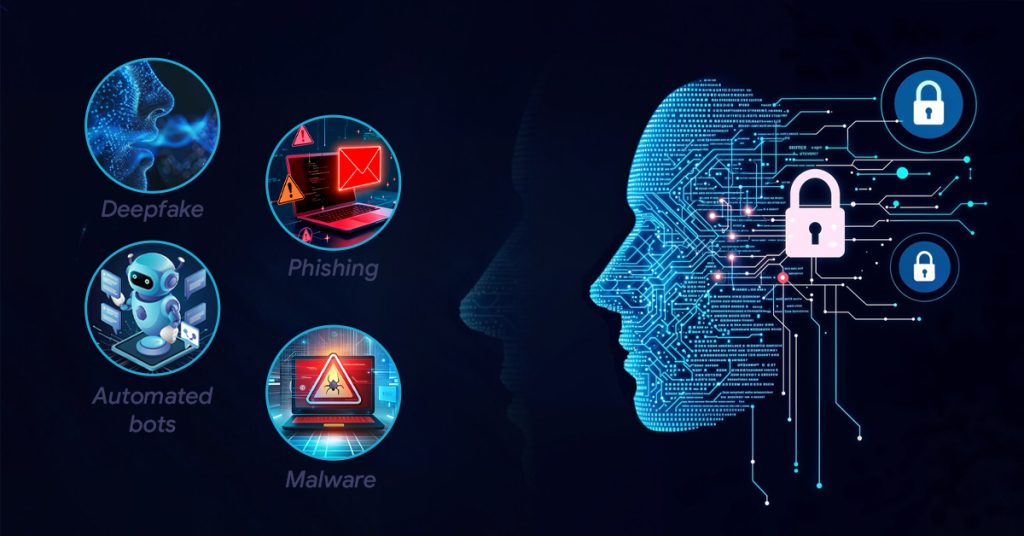
AI isn’t just helping defenders. Cybercriminals are getting smarter too.
Here’s what’s happening:
- Phishing emails now sound natural and personalized.
- Deepfake voices can imitate executives.
- Malware adapts to avoid detection.
- Automated bots scan thousands of systems within minutes.
We’re entering an era where attacks are no longer slow or manual. They’re automated, scalable, and constantly learning.
And that changes everything.
So How Is AI Fighting Back?
The biggest advantage AI has over humans is speed.
1. Instant Threat Detection
AI systems learn what “normal” looks like inside a network. When something unusual happens — like a login from a new country or abnormal file access — it flags it immediately.
No waiting. No guesswork.
2. Automatic Containment
In many advanced systems, AI doesn’t just detect a threat — it reacts.
It can:
- Isolate an infected device
- Block suspicious IP addresses
- Disable compromised accounts
- Trigger additional authentication steps
All before a human even opens a dashboard.
3. Predicting Attacks Before They Happen
This is where things get interesting.
AI can analyze past attack patterns and identify weak points before hackers exploit them. Instead of reacting to damage, organizations can fix vulnerabilities early.
That shift from reactive security to proactive defense is one of the biggest transformations in cybersecurity history.
But Let’s Be Clear — AI Isn’t Replacing Humans
There’s a common fear that AI will eliminate cybersecurity jobs.
In reality, the opposite is happening.
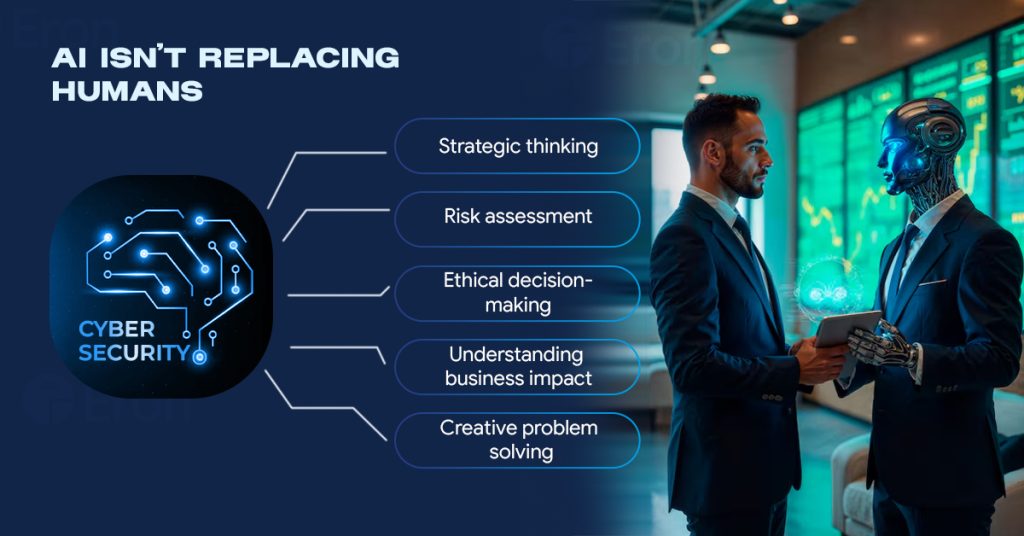
AI handles repetitive, data-heavy tasks. But cybersecurity still requires:
- Strategic thinking
- Risk assessment
- Ethical decision-making
- Understanding business impact
- Creative problem solving
Hackers think creatively. They exploit human psychology. They improvise.
AI doesn’t have intuition. It doesn’t understand context the way a human does.
The future isn’t AI replacing experts. It’s experts working alongside AI.
The Challenges Nobody Talks About
AI isn’t perfect.
It can produce false positives.
It can be manipulated.
It depends on the data it’s trained on.
And if attackers poison that data, the system can make bad decisions.
There’s also the issue of transparency. Many AI models operate like black boxes — they detect something but can’t clearly explain why.
That’s why human oversight is critical.
AI should be a tool — not an unchecked authority.
The Future: AI + Human Intelligence
Looking ahead to 2025 and beyond, cybersecurity will likely become an AI-powered ecosystem.
We’ll see:
- Smarter zero-trust systems
- Behavioral authentication replacing passwords
- AI-powered security operations centers
- Real-time risk scoring across entire infrastructures
But no matter how advanced technology becomes, one thing won’t change:
Security will always need human judgment.
AI may react faster.
Humans decide what matters most.
Conclusion
Cybersecurity in the future isn’t about machines replacing people.
It’s about using AI to handle the speed and scale of modern threats — while humans provide strategy, ethics, and adaptability.
Hackers are evolving.
Defenders must evolve faster.
AI is not the end of cybersecurity professionals.
It’s the upgrade they needed.
And the organizations that understand this partnership — not the replacement myth — will be the ones that stay secure in the years ahead.